
Spike Bucklow worked at the Hamilton Kerr Institute, paintings restoration studio of the Fitzwilliam Museum. He was originally trained as a chemist but has always had an interest in the arts. In the 1980s, he made special effects for block-buster movies, but has since spent twenty years working on the oldest paintings in Britain. His in-depth examination of great paintings has resulted in ground-breaking research into the science and craft of artists from the late 13th century to the early 20th century.
Tabs navigation
Cite BOOK
Close the cite modalStyle
Bucklow, S. (2009). The Alchemy of Paint. Art, Science and Secrets from the Middle Ages. Equinox Publishing. https://doi.org/
Bucklow, Spike. The Alchemy of Paint: Art, Science and Secrets from the Middle Ages. Equinox Publishing, 2009. Book. https://doi.org/
Bucklow, S (2009): The Alchemy of Paint: Art, Science and Secrets from the Middle Ages, Equinox Publishing, [online] https://doi.org/
Bucklow, S. The Alchemy of Paint. Equinox Publishing, 2009.
Bucklow, Spike. The Alchemy of Paint. Equinox Publishing, 2009. doi.org:
Format
Book
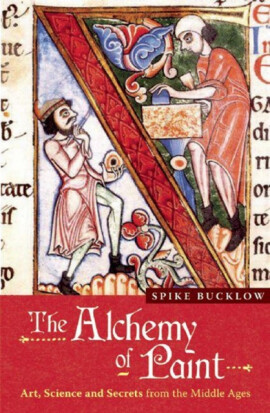
The Alchemy of Paint
Toggle the cite modalArt, Science and Secrets from the Middle Ages
The Alchemy of Paint examines pre-modern artists’ recipes for a handful of pigments, including lapis lazuli, gold and vermilion. It has become a widely-used text in the undergraduate and postgraduate teaching of the history of ideas, medieval art history and the history of science. Historic pigment... Read more
Published: 2009
Pages: 336
Paperback: 9780714531724
ePub: 9780714522500
The Alchemy of Paint examines pre-modern artists’ recipes for a handful of pigments, including lapis lazuli, gold and vermilion. It has become a widely-used text in the undergraduate and postgraduate teaching of the history of ideas, medieval art history and the history of science.
Historic pigment recipes – many of which were reconstructed by the author – provide evidence that practicing craftspeople had a detailed grasp of the sophisticated physical and cosmological theories that defined reality in pre-modern Europe. As such, the book is an in-depth, and heavily-referenced, primer for the pre-modern European world-view. For example, the chapter on the purification of lapis lazuli – to make ultramarine – is a practical example of how so-called Aristotelian four-element theory helped people engage productively with the material world.
The first half of the book shows how theories – like the four elements, hylomorphism, emanation, etc – were reflected in practice in recipes that ‘worked’, as well as in recipes that ‘did not work’ – like dragonsblood and mercury blue – but were nonetheless faithfully repeated. The second half of the book revisits materials – including vermilion and gold – to show that widely-recognised multi-levelled meanings were inherent in materials. Physical materials could therefore contribute metaphysical meanings to the mainly religious objects that incorporated them.