
-
The Buddha's Middle Way
Robert M. Ellis, Stephen Batchelor
The Middle Way was first taught explicitly by the Buddha. It is the first teaching offered by the Buddha in his first address, and the basis of his practical method in meditation, ethics, and wisdom. It is often mentioned in connection with Buddhist teachings, yet the full case for its importance ha...
-
The Thought of Sangharakshita
Sangharakshita (1925-2018) was a Buddhist writer and teacher, founder of the Triratna Buddhist Order and Community (previously FWBO). Apart from his practical achievements, Sangharakshita was an original thinker on the adaptation of Buddhism to modern conditions, an autodidact whose intellectual cre...
-
Red Book, Middle Way
Jung's Red Book, finally published only in 2009, is a highly ambiguous text describing a succession of extraordinary visions, together with Jung's interpretation of them. Red Book, Middle Way offers a new interpretation of Jung's Red Book, in terms of the Middle Way, as a universal principle and emb...
-
Archetypes in Religion and Beyond
The Jungian concept of archetypes is of immense value for critically distinguishing what is potentially of universal practical value in religious and other cultural traditions, and separating this from the dogmatic elements. However, Jung encumbered the concept of archetypes with debatable construct...
-
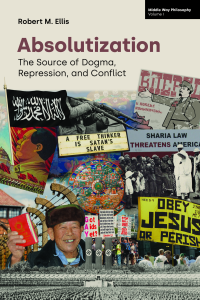
Absolutization
Robert M. Ellis, Iain McGilchrist
What do dogma, repression and conflict have in common? They all result from human judgement blocked from wider understanding by a false assumption of completeness. This book puts forward a theory of absolutization, bringing together a multi-disciplinary understanding of this central flaw in human ju...
-

The Five Principles of Middle Way Philosophy
This second book in the 'Middle Way Philosophy' series develops five general principles that are distinctive to the universal Middle Way as a practical response to absolutization. These begin with the consistent acknowledgement of human uncertainty (scepticism), and follow through with openness to a...
-
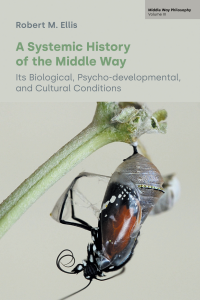
A Systemic History of the Middle Way
Robert M. Ellis, Iain McGilchrist
Systemic history is an approach to explaining the past, that tries to maximize our understanding of context. Unlike most history, it does not do this by just narrating a chain of causal relationships for a given group through time. Instead, it shows how simpler systems become more complex over ti...
-
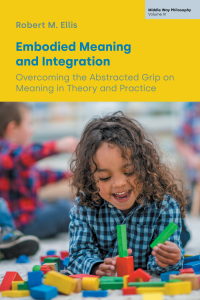
Embodied Meaning and Integration
Embodied meaning is a new approach to understanding the significance of all symbols, including those of language, as association in human experience. It has been developed since the 1980’s, but its full practical significance has rarely been applied, nor have the full challenges that it presents...